


Kugami
Gravestone Dance
 |
| A Dance of Solace in the Graveyard |
Introduction
For one
night a year, the hilltop graveyard in the coastal community of Kugami serves
as the stage for an extraordinarily unique tradition and otherworldly
spectacle: a communal dance around gravestones performed to the recitation of
tragic tales and rhythm of taiko drums.
History
Designated
as an intangible folk cultural property, exact dates and details regarding the
genesis of this unusual practice remain shrouded in mystery; the locals of
Kugami know from their own childhood recollections of this anticipated annual
celebration that they have danced in the graveyard since at least the Taisho
era (1912 to 1926).
To this
day, they still leave their homes as night lays claim to July 14th
of the lunar calendar and, paper lantern in hand, traverse steep paths cleft
through bamboo thickets to reach the crest of a coastal sand dune. There,
around the obelisk shaped gravestone of each
household that lost a family member within the lunar year, they dance to
welcome their spirit home for the Obon
festival – no matter the weather.
The Dance
In the
past, the heads of each household observing the first Obon for the departed would dress in full kimono complete with the family’s crest
and formally welcome each participating dancer
to the venue — their family grave. Dancers, in turn, would wear yukata. Now,
the custom no longer includes specifications on attire or formalities for host
or dancer.
Once dancers
have arrived at the venue, the dance itself begins. Each dance lasts 15 minutes
per gravestone and is simple enough to learn by following along: move your
hands in a motion that resembles scooping something up while taking supple
steps clockwise around the gravestone in a circular dance similar to the
typical Donen Odori, and dancers can join or exit the circle at any time. The
number of dances in a year depends on how many households have lost a family
member during the year; this year saw a total of six dances.
To provide
rhythm, a solitary taiko drum drums out a slow and steady beat. Meanwhile, a
singer-narrator recites one of the 20 different customary kudoki — a term for predominantly lyrical sections of traditional
samisen songs — which include works such as the tragic tales Yaoya Oshichi (Greengrocer
Oshichi) and Bancho
Sarayashiki (The Dish Mansion at the Bancho).
Atmosphere
Though the
idea of dancing to tragic poetry performed late at night around the gravestone
of the recently departed may come across as somewhat depressing and dreary, the atmosphere in the graveyard certainly isn’t; dancers and
spectators alike engage in jovial conversation between dances while drummers generously
share cans of beer carted with taiko in their plastic wheelbarrows. Then, in
one lantern-lit procession down midnight paths, the celebration heads to the
next venue.
 |
| Wheelbarrows of Taiko Drums and Beer |
Invitation
Fancy a
late night dance in the graveyard? Feel free to join the next Kugami Gavestone
Dance; after all, this is a gathering that enforces no dress code, expects no reservations, and intends to
welcome everyone — both the living and formerly so — to the family grave.

Details: https://www.tottori-dentou.net/dantai_detail.php?id=74 (Japanese Only)
Hinamatsuri:
An Imposter
 |
| Heian style dolls (Nagashibina Doll Museum) |
Beneath
The Spreading Japanese Plum Tree
With this philosophy came the idea that calendar dates that featured a repetition of odd numbers — such as the third day of the third month of the year — represented an auspicious occasion, and these dates were collectively termed the Gosekku (Five Seasonal Festivals) in Japan. Thus, over 1,000 years before being renamed Hinamatsuri, March 3rd was first given the name Joshi (上巳) which has the approximate English meaning of “First Day of the Snake of the Third Month” and Chinese Zodiac pedigree. Coincidentally, it also happens to be around the time of the year that Japanese plum trees flower which explains the day’s alias as Momo no Sekku (Plum Festival).
Party
Like It’s The Day Of The Snake
Genji
Atones For Partying Too Much
Genji:
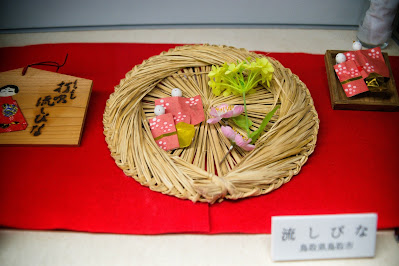
The Patron Saint Of Nagashibina
 |
| Nagashibina raft and agamono (Nagashibina Doll Museum) |
Thus, Genji’s doppelganger serves as a
spiritual garbage bag for his sins and misfortune and carries them far out to
sea to trouble him no further. Unfortunately for him, no sooner does his doll
disappear beyond the waves than a terrifying storm blows in from the sea and
engulfs the entirety of Suma. Eventually the storm passes, Genji’s
transgressions are forgiven, and he returns to a hedonistic existence in the
Heian court; however, in just a few short decades, the heydays of courtiers
like Genji, along with all of the frivolity, roguish behavior, and court
intrigue that exemplified their gay life, come to a violent conclusion. These
classical men of leisure that prioritized poetry, literature, beauty, and
romantic love above all else suddenly found themselves at the cutting point of
the swords and spears of men cultivated for war. Chased out of their ornate palaces
and out to sea on barges, many nobles, including the child emperor, carried
their own misfortune to the bottom of the Shimanoseki Strait.
Dolls
Turn The Tables
 |
| Dolls from the Meiji period (Nagashibina Doll Museum) |
Hina, the name that came to represent these dolls, has its own etymological tale, and this story begins with the onomatopoeic word for the chirping sound of a baby chick: hi-hi (pronounced as “hee hee”). In Japanese, the verb to express the act of an animal making a sound is naku, and connected with a baby chick with the sentence particle to (pronounced as “toe”), which makes the phrase to describe a baby chick chirping hi-hi to naku. This was shortened to hi-hi-naku, and later to simply hina. This word, in turn, came to represent something cute, small, and cuddly — even going on to literally mean chick — and the dolls fit the bill.
In 1579, Megohime, a princess of the Tamura clan, left home to marry the young heir of the powerful Date clan, Date Masamune, at the age of 12. During the Sengoku period (1467-1615), a time of interminable civil war, such marriages were commonplace policy for cementing alliances. Mere child hostages in political marriages, these brides hugged their cherished childhood dolls to their chest as they climbed into the palanquin for the nuptial procession that would take them to a foreign land and a stranger’s bed. Customarily, it was purported that the dolls would intercept and absorb any misfortune lurking along the road to their husband’s home, and thus they regained some of their former function as agamono.
This custom became so widespread and
popular that the dolls were considered an indispensable wedding accessory, and mothers
began passing them down to their daughters not as toys but as heirlooms for use
on the occasion of their own wedding. The Edo period arrived and brought an end
to the long years of ceaseless civil war, and the need for children hostages in
diplomacy greatly decreased. In this time of peace and stability, marriage was
widely considered the most auspicious occasion in a woman’s life, and young
brides no longer needed the fond memories stored up in their favorite plaything
to comfort them on their nuptial procession. The dolls once again lost most of
their function as agamono; instead, thanks to their close association with
weddings, they started to symbolize womanly happiness.
 |
| Dolls from the Showa period (Nagashibina Doll Museum) |
With their newly acquired status as an
image of happiness, parents with young daughters began to display their
heirloom dolls on March 3rd as a way of praying for their daughter’s
happy marriage. Ironically, it was a desire to keep these former toys out of their children's hands that led to their display on decorative platforms with the most precious dolls positioned highest up and furthest out of reach. By now, the dolls were widely referred to as hina, and the Edo
government declared March 3rd a national holiday for the observance
of Hinamatsuri. In other words, from
1687 until today, March 3rd has been celebrated as the Festival of Dolls!
Today
And Tomorrow And Beyond
The
Nagashibina Doll Museum
 |
| Nagashibina Doll Museum |
The museum also carefully preserves the
traditional ritual of Nagashibina. On the historically appropriate day of March
3rd on the lunisolar calendar, which falls around the middle of
April on the Gregorian calendar, participants follow the ritual once performed
by Genji to make dolls and rafts out of paper and straw, transfer their
troubles to their agamono, and then set it afloat on the Sendai River. Whether
looking to shed some winter sin or simply interested in witnessing one of the
oldest rituals in Japan, everyone is welcome, and the museum offers workshops
for making the dolls and rafts.
To conclude, Joshi combined with Winding Stream Parties and the Shinto ritual of agamono to give rise to Nagashibina, which in turn combined with doll play and wedding traditions to give rise to Hinamatsuri. In these days of progress and its corollary all-out war on traditional norms, the dolls that required nearly a thousand years to become synonymous with March 3rd will not easily retake their position as agamono, toys, tokens of solace, or symbols of womanly happiness; moving forward, their role as purveyors of history will likely define them. Ironically, exhibitions and activities in museums, shrines, and other historical facilities may be the only future left for these little dolls.
 |
| The long road of a fond memory... |
Japan's Representative Food
Quick question: what food do you imagine when you hear "Japan"? If
you answered "why, sushi of course!" as mostly everyone to whom this
question is posed do, then I'll pursue the matter further with a follow-up
question: what food besides sushi do you imagine when you hear
"Japan"?
Allow me to presume that your answer includes noodles; if not,
please take a moment to let me know what non-noodle dish represents Japan for
you in the comments and, for the time being, pretend. Before proceeding any
further, I should confirm that, despite a veritable cornucopia of noodle dishes
in Japan, we all agree that there can be only one noodle to represent Japan,
and that it must be made from the buckwheat that the Japanese have been
producing since even before the Nara period (710 - 794) to nutritionally
compliment their staple food of white rice, and that all of the newcomers and
flashy upstarts such as yakisoba, champon, ramen, and tsukemen should hereafter
only receive the tepid consideration reserved for distant relations of the
fabulously successful. So, of course, we agree that soba reigns supreme.
Maybe not the prettiest, but a very special soba...
Go to the Dojo
Now that we've settled on Japan's other most representative food, let's imagine
someone close to you - say, for the sake of argument, your immediate supervisor
- told you to go and pound soba, where would you start? No - no reason for
anger: telling someone to go pound soba is not a rebuke; in Japanese, the verb
used is "打つ", which means "to hit", and strikes me as far more
apt a description for the actions involved in the process. But I
digress.
First, make an appointment to receive training from a soba
master at the Shikano Soba Dojo.
The lesson fee is \110 per person, but individuals and groups alike must also
pay a set fee of \2,860 for ingredients to make soba for four, so it's best to
bring a few friends along to split this and the resulting food.
Next, travel to the locality of Shikano in Tottori city. As always, I recommend riding a bicycle, but there is also a bus to Shikano from Hamamura Station (access details here). Once there, change into a soba making gi, wash your hands, and do a few warm-up stretches.
Soba punching gi (apron) provided for use by the Dojo
Pound Soba
The Dojo uses buckwheat flour grown locally in Shikano. Soba-beating black
belts can pound out ju-wari (literally "100%") soba using only this
buckwheat flour; however, due to its dry, crumbly consistency, white belts will
find themselves punching above their weight. Therefore, wheat flour is mixed in
as a form of edible glue to make hachi-wari (literally "80%) soba.
Training begins with an easy warmup of dumping buckwheat and wheat flour together in a huge wooden mixing bowl. Next, add in water while mixing with by hand as the aroma of buckwheat flour fills the room. After all of the water has been added and the dough formed, knead the soba dough by rolling it around the edge of the bowl until it becomes smooth and glossy.
I received plenty of help and learned techniques from a local expert, though I did think the tables a little short for the vertically endowed.
After kneading out all of the cracks and dents, the real workout begins: put the dough on the table and then squish it into a disc of 20 cm in diameter. Next, take the large wooden roller in hand and stretch out the dough using the traditional technique: start in the middle, push the roller in one long continuous stroke and slide hands from the middle to the edges of the roller, repeat 3 times, and then change the direction of the dough. Continue until the dough reaches about 40 cm in diameter.

Weapons Training
Next, position a wooden straightedge atop the folded dough near the edge and, with the left hand, press it down with just enough strength to keep it stationary while not squishing the dough; with the right hand, aim a soba-kiri knife at the sliver of soba dough jutting out from underneath the straightedge.
The goal is to cut noodles with a uniform thickness of 2mm, and
this is done by using the straightedge as a guide for inserting the blade,
slicing back, and then tilting the blade to push the straightedge back 2 mm in
preparation for the next cut.
Japanese tamahagane breezes through soba dough
Results may vary. Even though my first cuts resulted in
extra-thick noodles, after much practice, I began to cut, slice, and tilt to
such a regular rhythm that I felt like I'd become a soba
artisan.
It’s Better to
Share
The taste of noodles freshly made by my own hand, I'm sure, is fantastic. But I wouldn't know. The sight of soba of such diverse shape and size beat and cut by my coworker proved irresistible, and was delicious. In turn, he ate all of my noodles in a breathless race without even looking up.
A highly memorable lunchtime adventure
 |
| Governor Shinji Hirai and Governor Phil Scott celebrating the Sister State Agreement |
Hot
Running
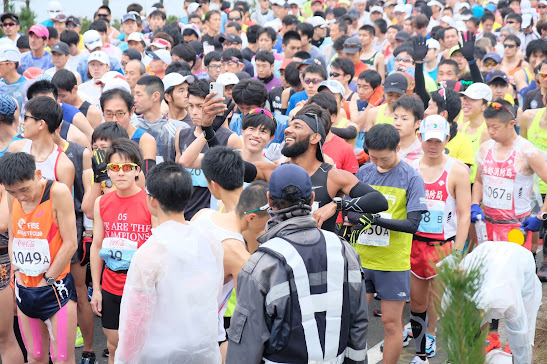
This unusual association of reggae to running traces back to March of 2016 when two local runners, one male and one female, performed exceptionally well in the Tottori Marathon. For their effort, they won a trip to Jamaica to participate in the Reggae Marathon, Jamaica’s premier international marathon event.

The race starts before the sun and temperature rise.
Bob Marley: Carry-on or Check-in?
Since that hosting of the Reggae Marathon
in December of 2016, runners from Tottori have raced in every subsequent hosting
of the event. Moreover, they have claimed victory in the men’s full marathon
division every year; to date, a total of four Bob Marley trophies and one Rita Marley trophy have relocated to Tottori.
Tottori boasts the highest ratio of people to Bob and Rita Marley trophies in Japan.
In return, runners from Westmoreland have participated in every hosting of the Tottori Marathon since 2017.
 |
| Jamaican runner becomes an instant celebrity in the Tottori Marathon (Japanese). |
Sumo Are Wasted on Cross-country
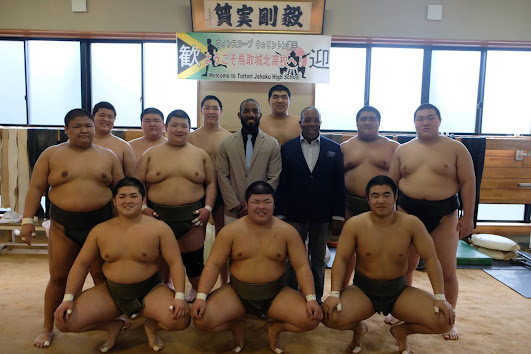
This mutual marathon exchange has not only
sown the seeds of grassroots internationalization along the marathon courses in
Tottori and Westmoreland, but also in the sports associations, schools, and
businesses that have cooperated in the program.
 |
| A warm welcome from the Johoku High School Sumo Stable. |
Unfortunately, the hosting of the 2020
Reggae Marathon event went virtual due to the impact of coronavirus. Therefore,
instead of enjoying the thirty-degree temperatures, sun and Caribbean Sea in
December, the runners of Team Tottori braved the cold of winter and
participated from some of their favorite spots to run in Tottori.
 |
| Interested? Visit the Reggae Marathon Official Site) |
Running from Japan
Watch this quick video created to share the joyful spirit of participating in the world’s most fun marathon and next time you encounter the word “reggae”, you too might feel like going for a run!
 |
| Reggae Marathon in Tottori |
A Special Performance Calligraphy Video Message
Tottori Prefecture and Westmoreland Parish share a special bond of friendship. Officially Sister Regions, they engage in a wide variety of international exchange activities. Amongst these, the annual youth exchange program, which is the first of its kind between Japan and a Caribbean Nation, has grown widely popular.
Unfortunately, the global spread of coronavirus necessitated the cancellation of the 2020 Tottori-Westmoreland Youth Exchange, and the high school students of Chuo Ikuei that were selected to participate ultimately missed out on an incredible opportunity to visit Jamaica.
But that didn't stop them from carrying out a cultural exchange: they decided to create and videotape a special performance calligraphy message to their friends in Jamaica.
Calligraphy, using brush and ink to write characters, is part of traditional Japanese culture. Performance calligraphy combines many of the traditional aspects of calligraphy with modern music and dance.

Please click the following link to watch their performance calligraphy video message.
Tottori Performance Calligraphy Video Message
Ametuchi: A Special Train in a Land
of Myth
 |
A c. 1885 CE illustration of
Izanami (left) and Izanagi (right) creating the islands of Japan with their
spear. |
“When heaven and earth began…”
These
words form the opening sentence of Japan’s oldest extant literary work, the; in
the original text, “heaven and earth” are represented by kanji characters read
as ametuchi. Written around 711, it chronicles mythical gods
and demons from the dawn of time in Japan, and many of these legends took place
in the San’in region. For a sightseeing train that runs through this land
steeped in myth and a cradle of early civilization, much the way the opening
sentence prepared its readers for the legendary tales to come, the name of
Ametuchi expresses a point of embarkation for a memorable journey.
Native Japanese
Pride in heritage: even while so many nations march onward with necks stiffened and eyes fixated on things to come, a sense of debt and desire to discharge it dutifully compels the people of Japan — to stop. Then, perched atop mossy rocks of ruined castle ramparts and under shaded approaches to forgotten shrines, they drop ancestral lines into the deep dark of history moats and wells; they know that the oldest well hides the most discoveries.
Exterior of Ametuchi |
This mytho-historic sensibility inspired nearly
every aspect of Ametuchi’s design: the azure exterior represents the sky and
sea of San’in while the silver design wrapped around the bottom imitates both
the temper pattern of a Japanese sword blade smelted in a tatara (traditional furnace) and the mountain ranges of San’in; overtop
all of this, a metallic finish gives expression to the divine atmosphere.
Amaterasu emerges from the
Heavenly Rock Cave (Shunsai Toshimasa, 1887) |
Folk Crafts on the Move
Inside, nearly everything mundane, utilitarian, and entirely expected of public transportation has been transformed into cultural crafts in a mythical motif. Overhead, colorfully dyed Inshu washi (traditional paper) adds an elegant tint and sense of mystique to the ambient lighting. On walls, indigo-dyed Kasuri and other traditional textiles decorate partitions. The restaurant style tables for four, two, and outward facing counter seats were all crafted from Japanese cedar and pine grown in the region. In this train, even the sink is a ceramic work of art from a local kiln.
Kagura costume miniature (Kagura
Shop Kuwanoki)
Edible History
Onboard services include meals produced to perfectly meld with the Native Japanese atmosphere; depending on the direction of travel, whether from Tottori to Izumo or the reverse, meal choices feature local specialties arranged in an artistic representation of the point of departure. As an example, the Ametsuchi Gozen Yoake lunch box expresses an amalgamation of the mythological worldview of the Kojiki and the picturesque scenery of San’in. For a more decadent option, the Oenosato Sweet Set offers seasonal pudding and roll cakes made with farm-fresh ingredients and no additives.
Ametuchi Gozen Yoake lunch
box |
Scenery
O

Since
the tracks traverse wide swaths of rice paddies, pierces through bamboo thickets,
and runs parallel to primeval beech forests, each season colors the world
beyond the window in its own vivid hues. In contrast, the farm villages tucked
into mountain roots and fishing communities lining the coast elude the passage
of time and appear as if unchanged from their construction hundreds of years
ago.

Details
Information on Ametuchi tickets and service schedule can be found here: https://www.westjr.co.jp/global/en/train/ametuchi/.
Japan’s
Oldest Triathlon Goes Decimal
The
Year of Tomeru
Every year in Japan since 1995 there is a
vote to choose one kanji character that best represents the events of that
year; for 2020, I’d like to nominate “止”(read as tomeru, literally “stop,”) as a worthy candidate. This year, even before the cherry blossoms
had a chance to attract crowds of admirers, thick clouds of tomeru swarmed the
wireless waves like mosquitos at a lakeside barbeque; at home, television and
internet cables spewed them forth in great black spurts; and in the public
square, big fat ones rested lazily atop colorful event posters.
Shock and a sense of loss accompanied the
first incidence of seeing a tomeru fixed atop the name of an anticipated event
like a cheap tombstone; now, with an entire year’s worth of events likewise
buried, and much in the manner that an individual grave appears less tragic
when seen from the vantage of a hilltop overlooking a vast cemetery, spectators
have grown numb to the spectacle. Even the events, it seems, have come to
accept this little piece of fate and last twist of the knife — they go without
a whimper.
At this juncture, I should make clear that my
purpose is not to explore the cause of this tomeru pandemic nor consider its
necessity; rather, I wish to use it as a backdrop and a stage for Japan’s
oldest and hardest triathlon.
The
Birth of Kaike Triathlon
Back in 1981, members of the Kaike Inn
Union gathered to plan a suitable special event for the 60th anniversary
of the Kaike Onsen, a beachfront Japanese style hot spring resort. Situated on
a coastline of white sandy beaches and giant black pines, Kaike Onsen had
already established a nation-wide reputation as a health spot: the hot water of
its hot springs sooth a wide variety of ailments and the shimmering waters of
the Sea of Japan invigorate. They therefore concluded to build upon this brand
identity by creating an event that epitomizes incredible health while also
utilizes the picturesque natural surroundings.
What they brought into existence not only
adequately achieved their purpose, but also would gradually develop into a
completely new identity for Kaike Onsen that has now, by some standards,
eclipsed the old. On August 20th 1981 at 7:00 a.m., 51 men and 2
women took part in Japan’s first triathlon.
Molding
Tetsujin
Since its humble beginnings, the race has
grown to such a gigantic proportion that it attracts over 1,600 applicants from
all over Japan vying for the maximum 940 individual and 80 relay team slots. At
first glance, this may not seem like an especially large number, but taking
into consideration the nature of the task, it certainly should.
The race opens with athletes in the Sea of
Japan where they battle waves, currents, and crowds in an open water 3 km swim
(120 lengths of a standard 25 meter swimming pool) along the coastline. Returning
to shore, drenched athletes peel off wetsuits and trade goggles for cycling glasses
and set out on a 140 km odyssey that takes them along river levee roads,
through large swaths of wetland rice fields, up 1,800 meters worth of elevation
at Mt. Daisen, and through shady tunnels created by leafy branches of old
growth beach forests. Finally, the cycling shoes come off, and on come the
running shoes, and athletes embark on the final leg of the journey: a full
marathon. This 42.195 km course begins in Kaike Onsen, continues along the Sea
of Japan into the city of Sakaiminato, and then turns back towards Yonago and
the finish line located on a 400 m track in a large athletics park.
If all of this still doesn’t sound
difficult enough, well then! here comes the best part: the competition is held in
the middle of July when temperatures reliably exceed 34 degrees! This is not an
accident; in fact, enduring Japan’s iconic summer sun is considered such an
integral part of the challenge that it inspired the competition’s moniker as “Red
Hot Kaike”.
Feel confident you can reach the finish
line? A resolute “Yes” is the absolute minimum requirement (there are many more
requirements) for even thinking of signing up. Even then, many challengers can
tell you from experience that saying is one thing and doing something else entirely:
20% that start the race do not finish. Those that do complete this race within
the time limit rightfully earn the title of tetsujin
(literally “iron human”).
Tetsujin
Vs. Tomeru
The slogan of Kaike Triathlon is “Brave and
True”, and under this banner many thousands of men and women have gathered to
test themselves in a ritual that demands both. In the seas off the coast of
Kaike Onsen where they swam, on the roads winding the foot of Mt. Daisen where
they cycled, and on the streets of Sakaiminato where they ran, sweat from the
burning bodies of these tetsujin has fallen; like sadness shed with every tear,
the will to overcome spilled out in sweat. Over the years, this indomitable
spirit has seeped into more than just the land and sea along the course.
This year should have marked the 40th
anniversary of the competition, and the organizers had planned on making it a
race worthy of the milestone; however, government measures and public pressure to
completely stem the spread of a contagion necessitated action, or, perhaps more
accurately, inaction. With hearts of lead, tetsujin watched as even this
legendary race began corroding under intense pressure into a “retire” before
finishing, a “did not run”, and a red-lettered “tomeru”. The integrity of this
historical competition and the spirit deposited in it fell into question.
Happily, it is a spirit that doesn’t like bending,
and many of the organizers — tetsujin themselves — possess it. Unwilling to
admit complete defeat to tomeru, they came up with an audacious
counteroffensive called the 39.5th Kaike Triathlon.
How is
Kaike 39.5 Different?
More than what it is, it is what it isn’t
that defines 39.5. First, it is not a full-blown competition: no awards await
the fastest athletes in each category. Second, the main adversary is not oneself:
the distance and difficulty of each stage have been greatly reduced. Third, it
isn’t a surrender in the recently popular Orwellian manner of “not losing” by
“not trying”: it is a defiant “no” to tomeru and a signpost to another
way.
The competition still begins with swimming;
however, unlike prior years, all 1,000 athletes don’t start in one large
flotilla upon the waves of the Sea of Japan. Instead, each athlete completes a
2 km swim on an individual basis and self-declares the result before arriving
on race day.
Next, the cycling portion has also
undergone a transformation. Instead of traversing the 140 km road course,
athletes set up their bicycle on stationary rolling devices spread out across a
grassy field. Then, at the starter’s signal, they peddle an equivalent of 50
km. Peddling in place means that athletes encounter no air resistance — a
double-edged sword. Though high rotation speeds are easier to maintain, the
cooling factor of actually moving at high speed is gone. So that athletes don’t
overheat, volunteers circulate and spray them with ice water.
Third, besides the course, the run remains largely
unchanged. Athletes still begin as soon as completing the cycling stage by
dismounting, changing shoes, and heading towards the start line. For 39.5, the
course takes them down a 16 km seaside cycling trail that connects Kaike Onsen
to Yume Minato Tower and then back for a total of 32 km. Closed to traffic, the
route is flat with magnificent views of the Sea of Japan, white sandy beaches, Japanese
black pine forests, and, towering in the distance, Mt. Daisen.
Finally, the largest difference between
39.5 and all of the previous iterations happens at the finish line: when each
athlete crosses, they turn and commend the organizers and volunteers for their audacious bravery.
Ginei
Kenshibu and the Greatest Duel in Japanese History

What is Ginei?
Ginei refers to a Japanese form of poetry recitation. The poem that will be discussed in this article is a kanshi poem (Japanese term for Chinese poetry as well as Japanese poetry written in Chinese) composed by Rai San'yo and titled “Fushikian Strikes at Kizan”. Here is the poem in Japanese with a full explanation of both the contents and context provided in the sections to follow.
不識庵機山を撃つの図に題す
鞭聲粛々夜河を過る
暁に見る千兵の大牙を擁するを
遺恨十年一剣を磨き
流星光底長蛇を逸す
Fushikian is the posthumous Buddhist name of Uesugi Kenshin, a powerful samurai lord of a domain called Echigo in northern Japan (Today’s Niigata Prefecture). Kizan is the posthumous Buddhist name of Takeda Shingen, a powerful samurai lord of a domain called Kai in central Japan (Today’s Yamanashi Prefecture). These two heroes and their armies fought in a total of five engagements at the famous site of Kawanakajima (1553 to 1564). This poem is composed in the form of a sympathetic exploration of the state of mind of Kenshin based upon the composer’s vast knowledge of Japanese history.
What
is Kenshibu?
Kenshibu is a traditional dance holding a
sword or a fan performed to the accompaniment of Ginei. The performer is
expected to exhibit the samurai mentality as well as the spirit of one who has
dedicated their life to the way of the warrior – just like Kenshin.
Tell
Me the Tale of the Greatest Duel in Japanese History!
In the dying hours of the starless night of
October 18th 1561, Uesugi Kenshin, lord of Echigo, leads a vanguard
of horseback samurai warriors across the Chikuma River. With cloth tied on the
bottom of their horse’s hooves and riding whips silent, they stalk through the
dark like an army of northern tigers on the prowl, and their prey is Takeda
Shingen, lord of Kai, camped with his army at Kawanakajima.
At the Takeda camp, a lookout glances an indistinct
shape moving beyond a veil of mist that hangs across the damp earth of the
riverbank like a curtain and he strains with all his might to determine whether
it’s only his imagination or not. At that moment, dawn stretches her arm out
across the horizon and through the mist, and the lookout spots the Echigo
cavalry charging towards him while arrayed tightly around their general’s
standard. Frantic calls to arm pull Takeda’s sleeping forces from their tents
and scrambling into defensive formations.
The rushing waves of cavalry smash into
Kai’s camp: spears snap, swords clang, and bones crack as waves of horseback
samurai wash over Kai’s hastily assembled lines. From all around, Kai reinforcements
let loose a savage roar of battle as they pour headlong into the fray; bloodied
men fall screaming to the mud, and an all-encompassing cacophonous din of war
soars into the red dawn sky.
Into the very vortex of this tempest of
steel, flesh, and blood rides Kenshin with such reckless abandon as to take
both armies by surprise. With single-minded determination, he rushes into a
breach in the enemy lines and, with enemy soldiers closing in on all sides,
races for the enemy command post. Bursting into Kai’s field headquarters, he charges
the last few meters separating him from Shingen who sits in his general’s chair
wearing full samurai armor and a look of genuine surprise.
Kenshin raises his sword and summons the
righteous fury of Bishamonten, the Buddhist god of war; the blade — polished to
a mirror — reflects the leaping flames of the brazier to appear as if wreathed
in flame. Shingen, caught completely off guard, leaps to his feet as the flaming
sword streaks like a shooting star towards the root of his neck; he manages to
fend off the strike with the only thing he has ready — his iron war fan. Their
eyes lock: Shingen reaches for his sword as Kenshin readies a second strike,
but a Takeda warrior spears Kenshin’s mount which causes it to flee.
The duel ends inconclusively, but the
battle rages on until the number of corpses from both armies littering the
field makes any further fighting difficult. Seeing the staggering amount of
death, Kenshin decides the cost of victory unacceptable and orders a retreat.
Later, while marching back to Echigo with his remaining warriors, the weight of regret seems to grow heavier the further he moves from the battlefield. For Kenshin, ten long years of war had culminated in that one precious opportunity to resolve his longstanding grudge against Shingen; in one brilliant flash, the chance disappeared forever.
What Does the Poem Mean?
Kanshi poetry is difficult to accurately
translate into English. Below is an approximation of the poem.
Fushikian Strikes at Kizan
Horse whips silent, river forged at night
At dawn see the General’s banner lead thousands of warriors
A grudge of ten year’s standing to polish one sword
Brilliant as a shooting star falls harmlessly
into dark


